A recrystallized carbonate rock composed predominantly of calcite, dolomite, or both; its mineralogy, grain, fabric, veining, and structural integrity directly govern how it can be carved.
Marble is a metamorphic carbonate rock formed when limestone, dolostone, or related carbonate rock is recrystallized by heat, pressure, and deformation. In geological usage it consists predominantly of interlocking crystals of calcite, dolomite, or both. The recrystallized texture may be very fine or coarse, and is often described as granoblastic or saccharoidal—a sugar-like mass of interlocking carbonate crystals.
The two principal mineralogical families
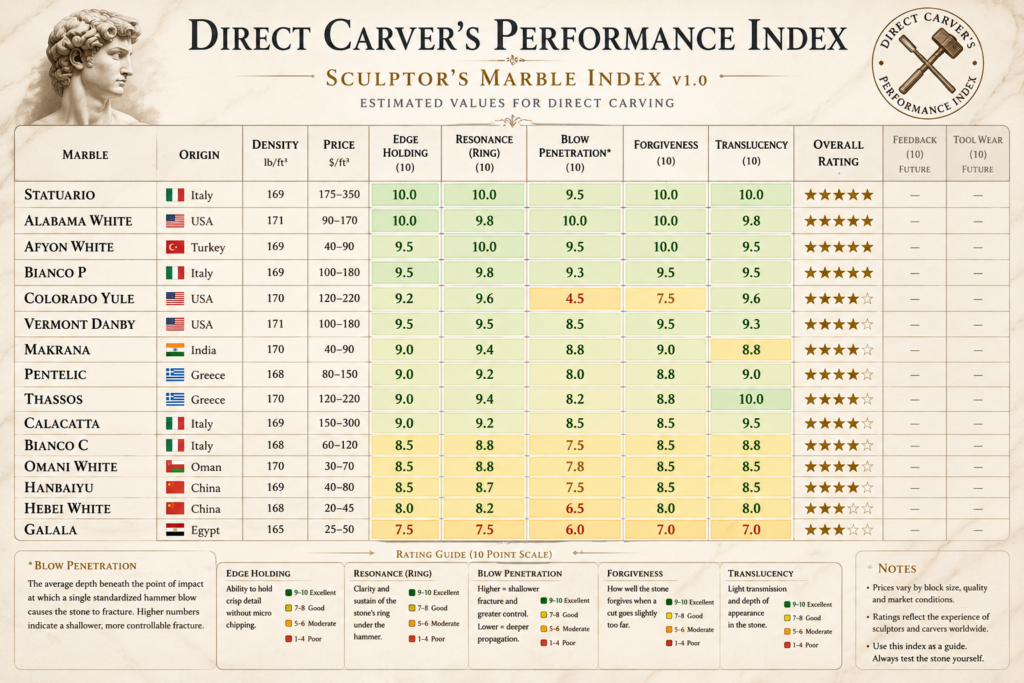
Calcitic marble is dominated by calcite, CaCO3. Calcite has a Mohs hardness of about 3. Many of the best-known sculptural marbles belong predominantly to this family. The classic white marbles of Carrara are chiefly calcitic, although the wider Carrara district contains several related lithologies. Colorado Yule marble is an exceptionally pure calcitic marble. On Thasos, the ancient Aliki quarries produced calcitic marble.
Dolomitic marble is dominated by dolomite, CaMg(CO3)2. Dolomite is somewhat harder than calcite—about 3½–4 on the Mohs scale—and reacts less readily with weak cold acid. Important sculptural examples include the white dolomitic marble of the Vathy–Saliara quarries on Thasos and the fine-grained Sivec marble quarried near Prilep in North Macedonia.
Thasos provides an unusually clear teaching example because both major marble types occur on the same island: Aliki is calcitic, while Vathy–Saliara is dolomitic. Archaeometric analysis can distinguish these quarry sources even when the finished sculptures appear broadly similar to the eye.
What matters to the sculptor
Mineralogy matters, but it does not by itself predict how a marble will carve. Grain size, crystal boundaries, preferred orientation, veins, mica or quartz inclusions, healed fractures, open fissures, and weathering history can matter just as much as whether the stone is calcitic or dolomitic. Two blocks sold under the same quarry name may therefore behave differently under the chisel.
Fine, tightly interlocked crystals can support delicate detail and crisp transitions. Coarser crystals may produce a more visibly crystalline surface and can respond differently at thin edges. Weak grain boundaries can lead to granular disintegration—often called sugaring—while veins and inclusions may be either visually desirable or structurally dangerous depending on their composition and orientation.
For the carver, marble must therefore be read as a material rather than merely chosen by color. Before committing to projecting fingers, drapery edges, unsupported limbs, or deep undercutting, the sculptor should study the block wet and dry, examine all available faces, identify veins and fissures, understand the quarry orientation where possible, and listen to the stone during cutting.
Marble and provenance
Ancient and modern marbles can often be connected to quarry sources by combining petrography with analytical methods such as stable-isotope analysis, trace-element chemistry, electron paramagnetic resonance, maximum grain-size measurement, and other archaeometric techniques. Provenance studies have distinguished, for example, calcitic Aliki marble from dolomitic Vathy–Saliara marble on Thasos and have characterized the fine-grained dolomitic marble of Sivec.
This matters historically because the choice of stone was not accidental. Quarry availability, block size, transport, workshop knowledge, carving behavior, cost, color, and prestige all influenced which marble a sculptor or patron selected.
Geological marble versus commercial “marble”
The geological definition should be distinguished from the dimension-stone trade use of the word. In commercial stone practice, marble has historically been used more broadly for stones that can take a high polish, including some materials that a geologist would classify differently. For the Sculptors Lexicon, the primary definition is the geological one: a recrystallized carbonate rock dominated by calcite and/or dolomite.
Marble’s great sculptural importance comes from an unusual combination of properties: it can be quarried in large blocks, accepts both forceful roughing and extremely fine cutting, can be abraded to subtle transitions, takes a high polish, and—especially in fine white varieties—can transmit a small amount of light below the surface, giving carved flesh a characteristic optical depth that opaque stones do not reproduce in the same way.
Etymology
Middle English marble, from Old French marbre, from Latin marmor, from Ancient Greek marmaros, meaning marble or a gleaming stone; the ultimate Greek origin is uncertain.
Sculptor Notes
For the sculptor: “white marble” is not a sufficient material description. Ask what mineralogical marble it is, where it was quarried, how coarse the grain is, how the crystals interlock, whether the block contains veins or healed fractures, and how it is oriented.
The distinction between calcitic and dolomitic marble is useful, but never let the classification replace direct observation. Dolomitic marble is mineralogically somewhat harder than calcitic marble, yet an individual calcitic block with tight grain boundaries may carve more cleanly than a structurally poor dolomitic block. The block itself remains the final authority.
Thasos is an especially useful comparison for teaching: Aliki supplied calcitic marble, while Vathy–Saliara supplied exceptionally white dolomitic marble. This demonstrates that quarry provenance and mineralogy must be considered together.
References
https://apps.usgs.gov/thesaurus/term-simple.php?code=5.2.5&thcode=4; https://pubs.usgs.gov/of/2004/1451/sltt/appendixB/appendixB.pdf; https://www.usgs.gov/publications/colorado-yule-marble-building-stone-lincoln-memorial; https://link.springer.com/article/10.1007/s12210-024-01298-x; https://onlinelibrary.wiley.com/doi/abs/10.1111/j.1475-4754.2009.00469.x; https://onlinelibrary.wiley.com/doi/10.1111/j.1475-4754.2012.00689.x; https://academic.oup.com/edited-volume/61673/chapter-abstract/548070206; https://www.etymonline.com/word/marble