The working from which natural stone is extracted—and, for the sculptor, the first workshop in the life of a stone sculpture, where geology, orientation, block size, soundness, provenance, procurement, and communication begin to determine the work.
Quarry is both a place and a process: the working from which natural stone is extracted from the earth, and by extension the act of extracting it. In the dimension-stone trades, a quarry may be open to the sky or worked partly underground; what distinguishes the work is not simply the shape of the excavation but the extraction of stone as usable material rather than the recovery of an ore for smelting or chemical processing.
The sculptor should understand the quarry not as a remote industrial supplier but as the first workshop in the life of a stone sculpture. Before a block reaches the studio, decisions have already been made about where in the deposit it is taken from, how it is oriented, how large a mass can be freed without fracture, where natural discontinuities occur, how the block is squared, and how it can be transported. Those choices can govern the possibilities of the sculpture.
Dimension stone and aggregate. Quarries serve very different industries. Aggregate production intentionally breaks rock into smaller material for roads, concrete, and construction. Dimension-stone quarrying instead seeks large coherent masses that can be cut into blocks, slabs, architectural elements, monuments, or sculpture. The sculptor belongs to the dimension-stone side of the quarry: value lies not simply in quantity of rock but in continuity, soundness, color, working quality, and usable volume.
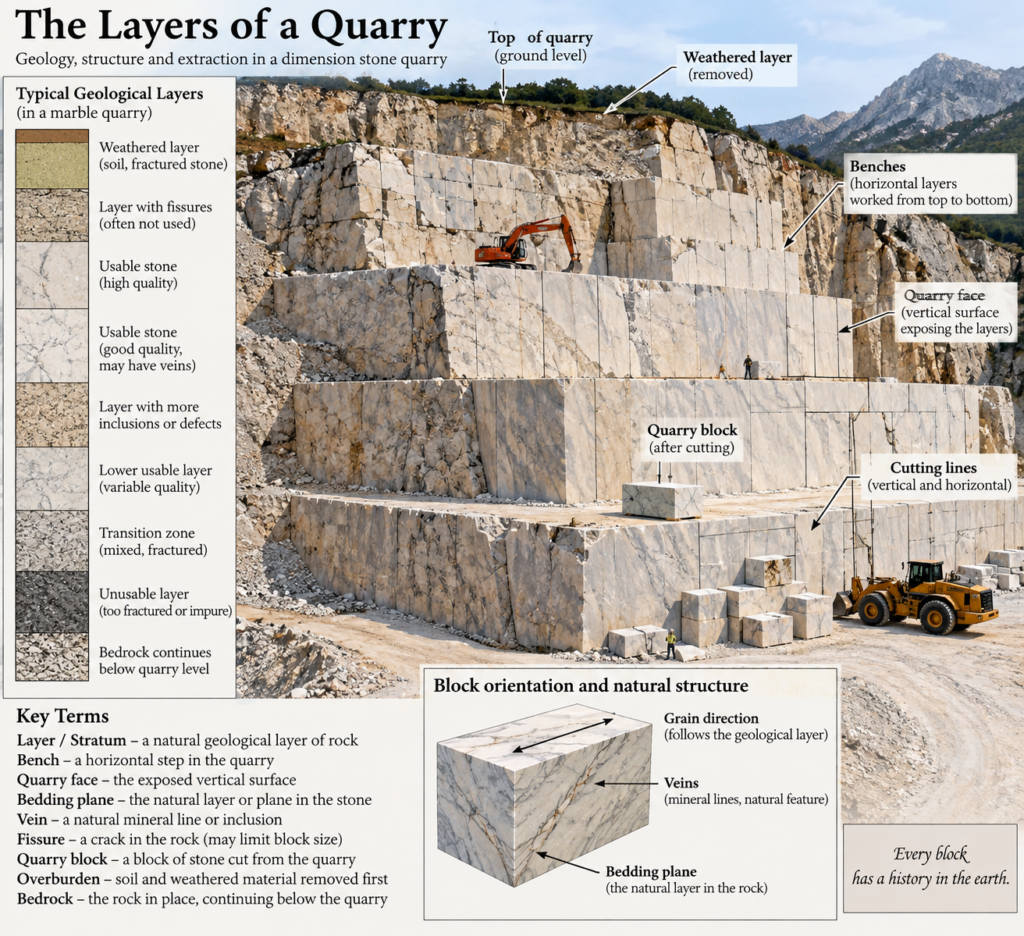
The quarry face. Stone is read in situ before it becomes a block. Bedding, foliation, veins, seams, fissures, stylolites, mineral inclusions, weathered zones, and changes in color may be visible across the face. Some features are decorative; others are structural weaknesses. A surface that appears insignificant on the mountain may pass completely through a block. Conversely, a dramatic vein can become a deliberate compositional element if its path through the mass is understood.
Orientation matters. Many stones have directional structure. Sedimentary stones may have bedding planes; metamorphic stones may display foliation or veining; some crystalline stones have preferred directions of splitting traditionally described as rift and grain. The orientation in which a block is removed and later carved can influence strength, splitting behavior, weathering, appearance, and the way the stone takes a tool. For sculpture, the desired figure therefore should not always be considered independently of the geological orientation of the block.
From mountain to block. Historic extraction depended on picks, trenches, wedges, levers, wooden or metal splitting devices, drilling, and enormous manual labor. Ancient Greek quarrymen could isolate a marble block by cutting a trench around it and then levering or splitting it free. Roman and later quarry faces preserve tool marks that record these operations. Explosive methods were later introduced in many districts, but for valuable marble they risked damaging usable stone. Wire-saw technology transformed extraction by allowing stone to be cut rather than shattered. At Carrara, helicoidal wire spread in the late nineteenth and early twentieth centuries; diamond wire became dominant in the later twentieth century. Modern quarries also use chain saws, drilling systems, heavy lifting equipment, and precision block cutting.
Quarry block. Once freed from the mountain, a large mass is reduced and squared into a transportable quarry block, usually approaching a rectangular prism. Squaring is not merely cosmetic. Removing irregular waste reveals more of the block, permits inspection, establishes usable dimensions, simplifies handling, and gives the sculptor or fabricator a clearer understanding of the available volume.
Quarry sap. Freshly quarried stone can contain natural moisture, traditionally called quarry sap in parts of the limestone industry. Fresh stone may therefore behave or appear somewhat differently from stone that has dried and equilibrated after extraction. Historic stoneworkers sometimes took advantage of freshly quarried material because certain stones could be easier to work before fully drying, although this varies greatly by stone type.
Provenance. A quarry is part of the identity of the stone. “Marble” is not one material. Carrara, Pentelic, Parian, Thasian, Proconnesian, Vermont, Yule, and countless other marbles differ in crystal structure, color, translucency, inclusions, durability, and carving behavior. Modern petrographic and isotopic analysis can sometimes identify the quarry district or geological source of ancient sculpture. Provenance therefore belongs to the material history of a work, not merely to its shipping record.
Communicating with a quarry or stone supplier. A beginner should learn to ask for stone in trade language rather than simply asking for “a nice piece of marble.” State the stone type or quarry if known, the minimum finished dimensions required, the preferred gross block dimensions, approximate weight limits, whether the work is for interior or exterior use, and whether veining, color variation, or inclusions are acceptable. Ask whether the block is sound, whether there are open fissures or repaired areas, whether it has been resin-treated, how the bedding or grain runs, and whether photographs are available of every accessible face.
When possible, request dimensions in a clear order—length × width × height—and confirm which face the supplier considers the bed or natural orientation. If a specific sculptural composition depends on the direction of veining, ask the supplier to mark the block orientation in photographs. For important work, a video walk-around, wet photographs, or an in-person inspection may reveal much that a single dry photograph cannot.
Allow for waste. The finished sculpture should never be ordered at the exact dimensions of the finished figure. The sculptor needs material for squaring, locating the figure, defects, working allowance, bases, projections, and possible changes during carving. A beginner should distinguish between finished dimensions and required block dimensions. The latter must include a safety margin determined by the design and the stone.
Price and logistics. Clarify whether the quoted price is for the raw block, a cut-to-size block, or material delivered to a particular destination. Ask whether cutting, squaring, crating, loading, port charges, customs, brokerage, insurance, and final delivery are included. Confirm whether price is based on cubic meter, cubic foot, ton, kilogram, or individual block. A low quarry price can become expensive after cutting and freight.
Communicating with the patron. The sculptor then has to translate quarry information into language the patron can understand. Natural stone is not an industrially uniform material. Veins, crystal variation, small inclusions, and tonal shifts are part of the material. A patron should understand the difference between normal natural variation and a structural defect. The sculptor should never promise perfect visual uniformity unless the selected stone genuinely supports that promise.
The patron also needs to understand that quarry selection affects schedule and cost. A suitable block may need to be located, extracted, cut, dried, transported, or replaced if inspection reveals a serious defect. It is wise to distinguish the sculpture price from unusual stone procurement, international freight, special cutting, or quarry selection costs when those costs are significant.
The sculptor as interpreter. The supplier speaks in blocks, beds, tons, cuts, grades, and freight. The patron speaks in image, finish, permanence, budget, and expectation. The sculptor must understand both languages. Good quarry communication reduces risk before carving begins; good patron communication prevents natural properties of stone from being mistaken for mistakes later.
The sculptor at the quarry. Historically, major sculptors understood this directly. Michelangelo spent extended periods at the Carrara and Pietrasanta quarries, selected marble, specified the dimensions and shapes of blocks, contracted with quarrymen and stonecutters, and became involved in the practical problem of transporting the stone. The quarry was not outside his creative process; it was part of it.
A quarry is therefore simultaneously geology, workshop, landscape, archive, marketplace, and point of origin. Tool marks on abandoned faces preserve working history; the quarry itself records centuries of extraction; and each block carries a specific geological history into the studio. For the stone sculptor, to know the quarry is to know the material before it becomes sculpture.
Etymology
Middle English, through Old French quarriere / Medieval Latin quarreria, from a root connected with Latin quadrare, “to square.” The historical sense is literally a place where stone is squared or prepared as blocks.
Sculptor Notes
For the sculptor, block selection is already design. A block is not neutral raw material waiting for an idea to be imposed upon it. Its dimensions, fractures, veining, bedding, translucency, inclusions, and orientation establish conditions to which the design must respond.
When choosing a block, read all six available faces and ask what continues through the mass. Look for open seams, hairline fissures, healed fractures, clay or mica bands, pyrite, sugary or friable zones, changes in crystal size, and weathered edges. Wetting the surface may reveal veining and color that are difficult to see dry, but a beautiful surface does not guarantee a sound interior.
A beginner's supplier checklist: stone name and quarry; block dimensions; approximate weight; photographs of all faces; wet photographs if useful; bedding/grain direction; known fissures or repairs; resin treatment; interior/exterior suitability; cutting allowance; price basis; cutting charges; loading; freight; insurance; delivery terms; and expected lead time.
A beginner's patron checklist: confirm the stone selected; explain natural variation; show photographs or a sample where practical; identify obvious veins or features that may remain visible; explain that hidden defects cannot always be predicted; state whether procurement and freight are included in the commission; and explain that final carving orientation may be adjusted to respect the stone.
Never hide uncertainty from either side. If a supplier says a block has a seam, ask what kind. If a patron demands a perfectly uniform natural stone, explain what is realistic before the commission proceeds. The sculptor earns trust by translating accurately, not by promising away the nature of the material.
Think three-dimensionally before cutting. A vein that enters one face has a direction; a defect seen on two faces may define a plane through the block. Map these features mentally—or literally—before deciding where the figure lives. The most intelligent use of stone is not merely to avoid every variation, but to know which variations are structural defects and which can become part of the sculpture.
For direct carving, the quarry deepens the meaning of “carving from the block.” The sculptor is not beginning with an abstract cube. The block is a piece of a mountain with an orientation, geological history, and memory of extraction. The first design decision may therefore occur before the block ever leaves the quarry.
Michelangelo's practice is instructive here. The Metropolitan Museum records that he spent long periods at Carrara and Pietrasanta selecting marble, specifying block dimensions, dealing directly with cavatori, scarpellini, and squadratori, and even concerning himself with the roads needed to move the stone. That is not logistics separate from sculpture; it is sculpture beginning at its source.
References
https://www.naturalstoneinstitute.org/default/assets/file/consumers/glossary.pdf; https://www.quarrying.org/about-quarrying/quarrying-explained; https://education.nationalgeographic.org/resource/quarry/; https://www.metmuseum.org/it/perspectives/michelangelo-carrara-marble-quarries; https://www.metmuseum.org/-/media/files/exhibitions/2014/journal49_riccardelli_pp048-116.pdf; https://www.carraramarbletour.it/en/culture/il-marmo-le-tecniche-di-escavazione/; https://www.dictionnaire-academie.fr/article/A9C0915