An application of Vitruvius's ordinatio to sculpture: the measured organization of individual members according to a module derived from the work itself, so that each part belongs proportionally to the whole.
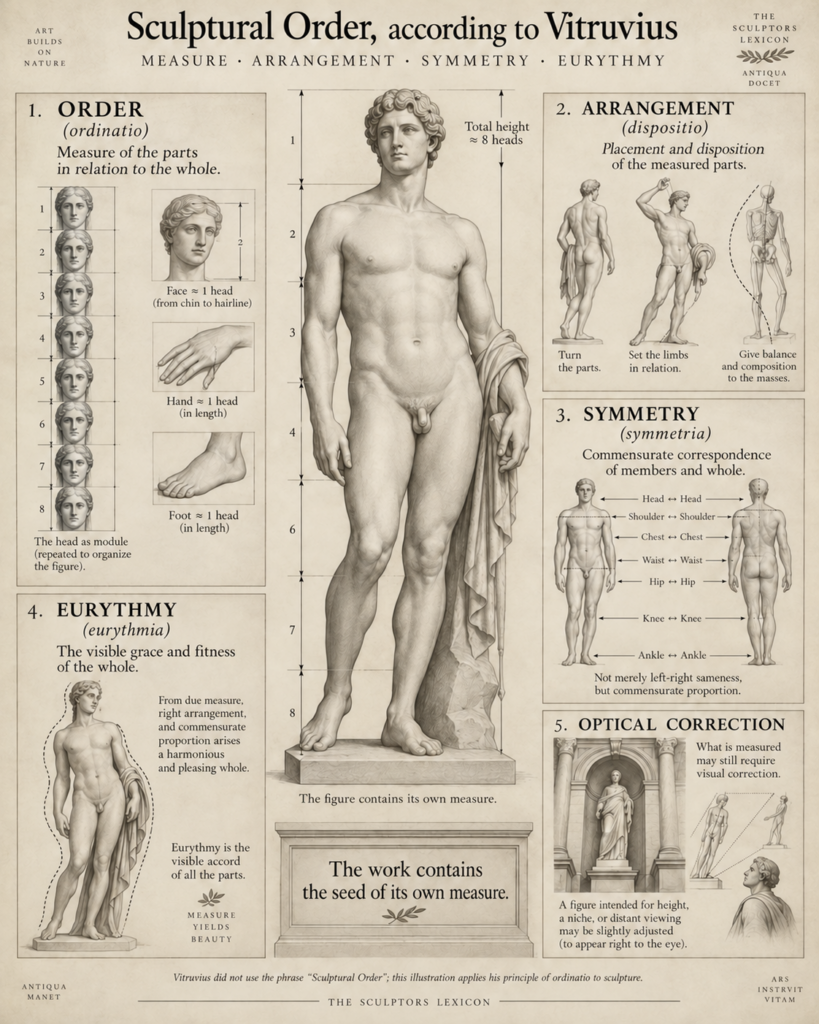
Sculptural Order is an application to sculpture of Vitruvius’s principle of ordinatio—Order. Vitruvius himself writes about architecture, not a separate doctrine called “sculptural order,” but his definition of Order, his account of proportion in the human body, and his explicit reference to celebrated ancient painters and sculptors provide a strong classical basis for extending the principle to sculpture.
In De architectura I.2, Vitruvius names six fundamental principles: Order (ordinatio), Arrangement (dispositio), Eurythmy (eurythmia), Symmetry (symmetria), Propriety or Decor (decor), and Economy or Distribution (distributio). Order is therefore not the whole of composition. It is one operation within a larger system.
Order is measure. Vitruvius defines Order as the giving of appropriate measure to the individual members of a work and the bringing of the proportions of the whole into agreement. He says it arises from quantitas—quantity or measured magnitude—and that quantity is established by selecting modules from the members of the work itself and using those parts to generate the whole.
This is crucial. The module does not have to be an arbitrary measuring unit imposed from outside. It can arise from the thing being designed. In a human figure, the head, face, hand, foot, cubit, palm, finger, or another structurally meaningful part can serve as a reference by which larger relationships are judged.
Order and the human body. In Book III Vitruvius explains architectural proportion through the human figure. He lists relationships among the face, head, hand, foot, cubit, breast, and total height, and remarks that ancient painters and distinguished sculptors used commensurate bodily proportions and thereby attained great praise. The point is larger than any one numerical canon: a well-formed whole is understood through the measured correspondence of its members.
Applied to sculpture, Sculptural Order is therefore the measured organization by which the dimensions of individual parts are established in relation to one another and to the complete figure or composition. A hand is not simply “the correct size”; it is correct in relation to forearm, arm, torso, head, gesture, scale, and the governing character of the whole.
Order is not Arrangement. Vitruvius distinguishes ordinatio from dispositio. Order determines measured relationships; Arrangement concerns the appropriate placement and disposition of the parts. In sculpture, the proportion of the head to the torso belongs primarily to Order. Turning that head, shifting it off the central axis, raising one arm, or placing one figure against another belongs more to Arrangement.
Order is not Symmetry in the modern sense. Vitruvian symmetria does not primarily mean bilateral mirror symmetry. It means commensurability: a proper correspondence among the members themselves and between the members and the whole according to a chosen standard or module. A contrapposto figure may be profoundly symmetrical in the Vitruvian sense even though its left and right sides are visibly unequal.
Order is not Eurythmy. Order establishes measurable relations. Eurythmy is the beautiful and fitting appearance produced when the members are adjusted so that height, width, length, and other dimensions answer one another gracefully. Order can therefore be understood as part of the measured foundation; eurythmy is the perceived rightness of the resulting relationships.
Order can be corrected for vision. Vitruvius later warns that mathematically established proportions may require additions or diminutions according to viewing conditions because the eye can be deceived. Classical Order is therefore not mechanical rigidity. Measure establishes a rational starting structure; trained judgment may then alter that structure so that the work appears right from its actual position and distance.
For sculpture this has major consequences. A figure intended for a high façade, deep niche, distant monument, or low eye level may require enlargements, compressions, changes of projection, or emphasis that would appear excessive at studio distance. The ordered relationship is preserved in intention even when individual dimensions are optically corrected.
Sculptural Order is relational rather than formulaic. A canon may provide ratios, but Order is the deeper principle that makes a canon possible. The sculptor asks: What is the governing unit? How does each part answer that unit? How do secondary masses belong to primary masses? How does the smallest significant member participate in the total figure?
Thus Order is not merely measurement. It is the establishment of a hierarchy of relationships through measure.
Etymology
From Latin ordinatio, from ordo, meaning order, rank, arrangement, or regulated sequence. Vitruvius gives the Greek equivalent taxis (τάξις). The term Sculptural Order is a modern sculptural application of Vitruvius's principle, not a phrase used by Vitruvius himself.
Sculptor Notes
For the working sculptor: begin by identifying the major masses and the module by which they will be judged. In a figure this may be the head, but it does not have to be. The face, hand, foot, or another functional interval may become more useful depending on the work.
A practical sequence derived from Vitruvius can be stated:
1. Order — What are the measures?
Establish the governing module and the proportional relationships among the members.
2. Arrangement — Where do the members go?
Place, turn, overlap, oppose, or separate those measured parts to create the composition.
3. Symmetry — Do the members correspond?
Test whether each part participates coherently in the proportional system of the whole. Here “symmetry” means commensurability, not mirror equality.
4. Eurythmy — Does it look right?
Judge the visible grace, fitness, and rhythmic correspondence of the relationships. A mathematically possible proportion may still fail visually.
5. Optical correction — Will it still look right where it lives?
Correct for height, distance, foreshortening, niche, architecture, light, and point of view.
This sequence is valuable in education because it prevents students from confusing proportion with anatomy. Anatomy tells us what structures exist. Order asks how large they are in relation to one another. Arrangement asks what they are doing. Eurythmy asks whether the relationships have achieved visual unity.
Vitruvius's statement that the module may be taken from the members of the work itself is especially important for sculpture. It means that the work contains the seed of its own measure. The sculptor does not merely apply numbers to a body; the sculptor discovers a governing relation within the body and allows that relation to organize the whole.
This also helps explain why a great figure can depart from a textbook canon without falling into disorder. The specific ratios may change, but the relationships remain intentional, internally coherent, and visually answerable to the whole.
In short: Sculptural Order is the discipline by which no member is isolated. Each part receives its measure from its relation to other parts and ultimately from its participation in the whole.
References
https://www.perseus.tufts.edu/hopper/text?doc=Vitr.+1.2&lang=original; https://www.perseus.tufts.edu/hopper/text?doc=Perseus%3Atext%3A1999.02.0072%3Abook%3D1%3Achapter%3D2%3Asection%3D2; https://penelope.uchicago.edu/Thayer/E/Roman/Texts/Vitruvius/1%2A.html; https://penelope.uchicago.edu/Thayer/L/Roman/Texts/Vitruvius/1%2A.html; https://penelope.uchicago.edu/Thayer/E/Roman/Texts/Vitruvius/3%2A.html; https://penelope.uchicago.edu/Thayer/L/Roman/Texts/Vitruvius/3%2A.html; https://penelope.uchicago.edu/Thayer/E/Roman/Texts/Vitruvius/6%2A.html