Before the First Blow
John Fisher on Selecting Carrara Marble
A block can be beautiful and still be the wrong stone to buy. A white surface may conceal a fracture. A clear ring beneath a hammer may inspire confidence the marble does not deserve. The first task is to look carefully—and resist the urge to fall in love too soon.
After years of buying and carving marble around Pietrasanta, John Fisher begins with a practical inspection: defects, veining, natural surfaces, and the general shape of the block.
Each tells him something about what he may be able to carve, and what might stand in his way.
Let Water Reveal the Faults
John considers water his most useful test for finding surface fractures. Wet the stone and watch it dry. Moisture can remain in a crack after the surrounding surface has dried, making a concealed line easier to see.
Some defects announce themselves. Others require patience. A dark fracture may be obvious; a fine white line deserves closer examination.
Tapping the block adds information, but John warns against trusting the sound alone. A block can ring and still contain a defect.
“Spend as much time as you need to pick out your block,” he advises.
That time is cheap compared with discovering a fracture halfway through a sculpture.
Choose Marble You Can Work With
John recommends a good Carrara white marble as a practical starting point. In his experience, ordinary Carrara marble works relatively evenly in its different carving directions, making it a useful material for learning.
Statuario is his preferred carving stone. He values its translucency and the pleasure of working it, but sound material can be difficult to find and considerably more expensive.
Extreme whiteness, meanwhile, does not guarantee agreeable carving.
John is cautious about the marble he calls Bianco Pi. He describes it as very white, but difficult to work because of its pronounced tendency to break in one direction. A blow can remove more stone than intended. He also warns about small cavities in the material.
His preference is straightforward: choose stone that helps the work proceed.
Learn Which Way the Stone Wants to Break
John describes three working directions in marble: verso, secondo, and contro.
In his account, the verso breaks most readily, the secondo offers more resistance, and the contro is the hardest direction to carve. Their effect becomes especially important when a form grows thin or a projecting part approaches its final dimensions.
He generally places the verso vertically rather than from front to back. That is a choice within his own carving practice, informed by the form he expects to develop.
Knowing the stone’s direction gives the sculptor a better basis for judging each cut. The force of the blow is only part of the decision.
Watch for Small Holes
A tiny opening can lead to a much larger disappointment.
John warns about cavities that continue deeper as the sculptor tries to remove them. What appears to be a minor surface blemish may consume more of the intended form with every cut.
He also looks carefully at areas of unusually large crystals, which he considers a possible indication of a cavity within the stone.
A low price becomes less attractive when the usable marble keeps disappearing.
Consider Where the Defect Lies
A defect does not always make a block useless. John points out that a fracture may help release a large piece of waste stone.
Its position matters. A fault within material destined to be removed presents a different problem from one crossing the part the sculptor hopes to keep.
For a direct carver, the block’s shape and condition help guide the emerging work. An irregular piece may offer possibilities a squared block would never suggest. But that freedom still requires judgment: the sculptor must find enough sound stone to carry the form.
Some Answers Come Only Through Carving
When several faces remain hidden, John acknowledges that judging the block is difficult. The buyer is accepting uncertainty.
His own response is to explore the stone during the early reduction. As he removes approximately thirty percent of the block, he discovers its working directions, exposes suspect areas, and learns where the best material lies.
He calls this “tasting” the stone.
It is the beginning of a relationship with a particular block. The inspection continues through the tool, revealing what the surface alone could not tell him.
Give Yourself a Sound Beginning
John’s advice returns to a simple principle: make the work easier on yourself. Beauty and price should not persuade you to overlook defects that will compromise the carving.
Before the first blow, there is already work to do. Look at every accessible face. Wet the surface. Study the lines and openings. Consider the shape, the carving directions, and how much sound material the sculpture will need.
The finished work begins with that decision: choosing a stone worth your time.
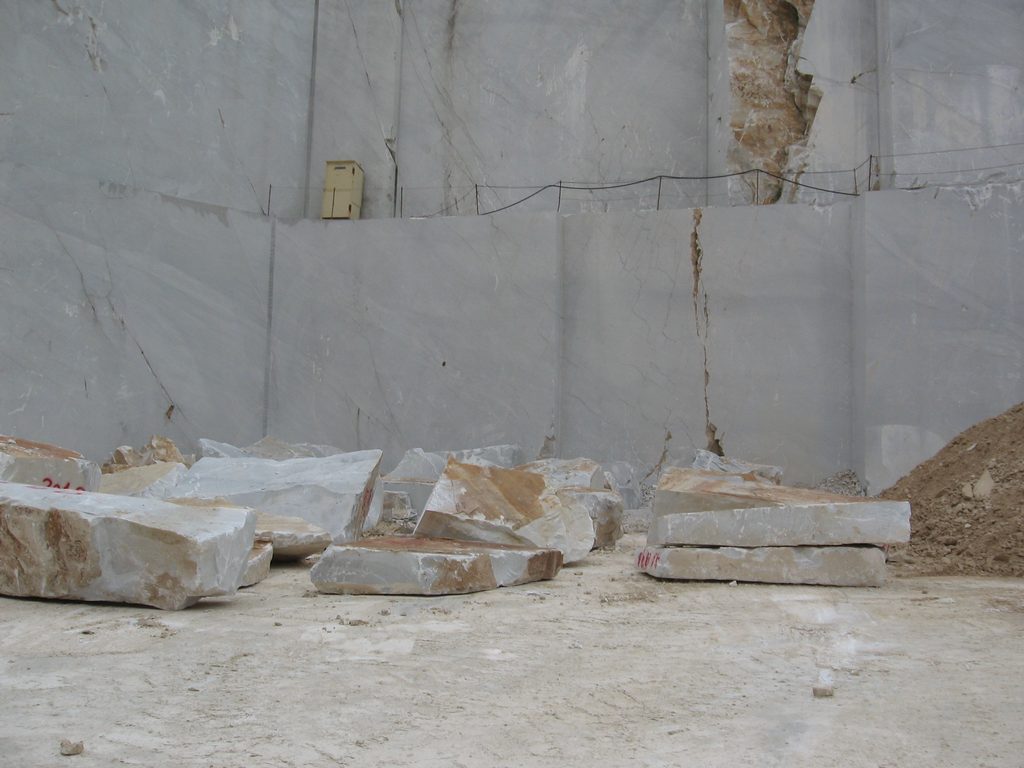
Faldi & Informe
Faldi are pieces of marble formed between roughly parallel natural fractures in the mountain. Those fractures define two opposing faces, often giving the stone a slab-like shape.
John explains that iron oxides can enter the fractures and stain those natural surfaces brown. The staining does not necessarily mean the marble inside is poor. Between the fracture planes, there may be sound white stone suitable for carving.
Faldi generally cost less than regularly sawn blocks. For a sculptor willing to work with their existing thickness and shape, they can offer excellent value. John has used them for both individual sculptures and public commissions.
The important distinction is that the natural fractures form the boundaries of the piece; you still need to check for fractures within it. John describes faldi as usually sound, not guaranteed sound.
An informe, by comparison, is an irregular, unshaped piece of marble whose form is not necessarily defined by two parallel fracture surfaces.