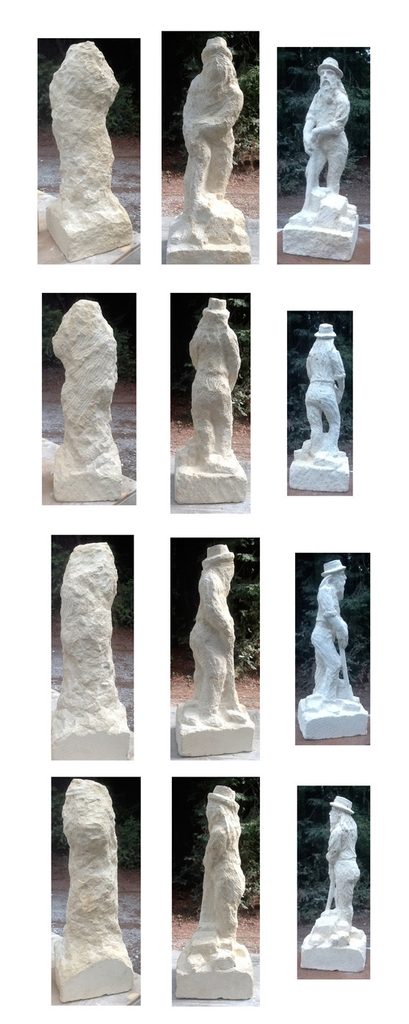
John begins without a model or fixed subject. He removes approximately 30% of the block while concentrating on abstract composition: thrusts, counterthrusts, negative space, and the relationship of masses.
Only afterward does he allow recognizable imagery to emerge from the remaining stone.
Once a figure appears, he begins what he calls profile carving.
Rather than driving a chisel into the supported mass, he carves the unsupported edges and silhouettes, moving around the sculpture and correcting each successive profile. He describes turning the work or changing his viewpoint by approximately five degrees and repeating the process.
John attributes several advantages to this approach: less force, faster removal of stone, fewer deep bruises, and continuous visual control of the emerging figure.
His method has a close relationship to your interest in direct carving and the sculptor’s ability to recognize form without mechanical copying.
I would preserve John’s detailed explanation substantially intact, with his authorship clearly identified.
One safety qualification is essential: although John suggests that profile carving often makes eye protection unnecessary, the Lexicon should explicitly require appropriate eye protection and other protective equipment. His experience is not a substitute for modern shop safety.